Love and Justice
When Love Is Not Enough
Listen to the radio show on ‘love and justice’
WKZE 98.1 FM, RED HOOK, NY
SHOW SUMMARY
Exploring the Interconnection of Love and Justice with Caroline Phipps
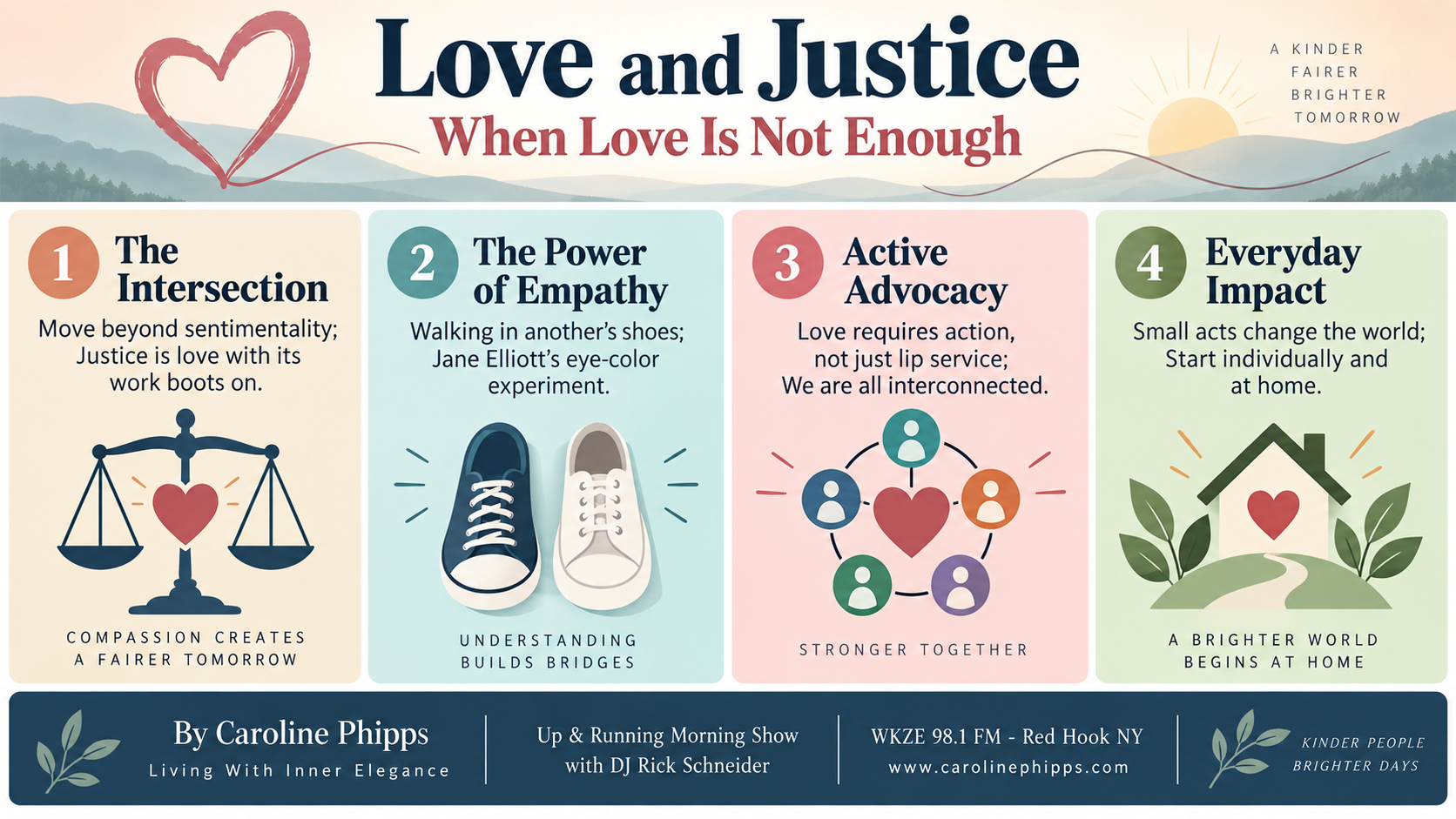
This insightful conversation between Rick and Caroline Phipps delves into the profound relationship between love and justice, emphasizing action-oriented advocacy over passive affection. The discussion centers around historical context, social experiments, and contemporary calls for collective responsibility, highlighting how justice embodies love in its most pragmatic form.
1. The Intersection of Love and Justice
Caroline Phipps introduces the idea that while society often pursues love, pursuing justice is equally essential. The key insight is that love alone is insufficient without the pursuit of justice, as justice represents love translated into tangible actions that address inequality and suffering.
The conversation draws on Jane Elliott's famous 1968 school experiment demonstrating the impact of privilege and discrimination through dividing children based on eye color.
This exercise highlighted how direct experience—walking in someone else’s shoes—develops deeper empathy than intellectual understanding alone.
Jane Elliott’s work has had a global influence, underlining the power of experiential learning in addressing prejudice.
2. Jane Elliott’s Legacy and the New Documentary
Caroline references the 2026 documentary Jane Elliott Against the World, directed by Judd Ehrlich, showcasing Jane’s lifelong activism and outspoken stance on injustice.
Jane challenges the notion that "love is all we need," suggesting instead that justice must come first.
She emphasizes the necessity for practical justice to underpin love, coining the phrase: “Justice is love with its work boots on.”
The film and Jane’s work prompt audiences to reconsider cultural ideals around love, especially those popularized in the 1960s and earlier decades.
3. Historical and Cultural Perspectives on Love and Justice
The show explores how the 1960s introduced a new cultural paradigm centered on “love is all you need,” intertwined with civil rights, peace movements, and social revolutions.
This era challenged traditional, conservative social structures that viewed love—particularly romantic love—as risky or subversive.
Classic literature like Madame Bovary and Anna Karenina illustrates historic skepticism about love’s power to transform lives without causing upheaval.
Jane Elliott’s upbringing during the 1930s rise of fascism informs her pragmatic approach: love without justice is naive and insufficient to prevent systemic harm.
4. The Relationship Between Collective Humanity and Action
Caroline explains that Jane Elliott views all humans as interconnected, meaning injustice anywhere affects all of us.
This interconnectedness fuels advocacy and justice work, driven by a shared destiny.
Current global unrest and heightened awareness underscore this shift toward collective empathy and responsibility.
The conversation reiterates that small individual acts of kindness and fairness contribute to larger societal change.
5. Practical Approaches to Being Just and Loving
Instead of feeling powerless in the face of global issues, Caroline encourages everyday actions grounded in kindness and inclusion as essential components of justice.
Advocacy does not require constant public activism; it includes small decisions, such as:
Cultivating empathy in daily interactions.
Contributing positively in group settings.
Supporting others with simple kindness that cascades through communities.
Self-care is critical: being personally well provides a stronger foundation to help others effectively.
Collective mindset matters: recognizing that what affects one affects all fosters commitment to justice rooted in love.
6. Upcoming Community Engagement and Resources
Caroline promotes ongoing community-building initiatives supporting these values:
Safe space community gatherings hosted monthly on Zoom, allowing open conversation and contribution.
Website carolinephipps.com offers an archive of past shows with insights on social and spiritual wellbeing.
Encouragement for listeners to participate and foster justice through love within their own lives.
Summary Table: Key Concepts of Love and Justice in the Dialogue
Concept: Love without justice
Explanation: Considered insufficient; love must be paired with active pursuit of fairness and equity
Quote/Reference: Jane Elliott: “Love is not enough”
-
Concept: Justice as love in action
Explanation: Justice is the practical, “boots on” work of love applied to social conditions
Quote/Reference: “Justice is love with its work boots on”
-
Concept: Empathy through experience
Explanation: Feeling another’s experience deeply fosters understanding beyond intellectual knowledgeJane
Quote/Reference: Elliott’s eye-color experiment
-
Concept: Interconnected humanity
Explanation: What happens to one impacts all, inspiring collective advocacy
Quote/Reference: Global awareness of shared suffering
-
Concept: Everyday advocacy
Explanation: Small acts at personal and community levels contribute to systemic change
Quote/Reference: Acts of kindness, inclusive contributions
-
Concept: Self-care importance
Explanation: Being well individually enables sustainable contribution to justice and love
Quote/Reference: “If you’re solid, then you can help others”
Key Insights
Justice complements love by providing a framework for meaningful, equitable action.
Empathy gained from experiential learning transforms passive awareness into active commitment.
Social movements and cultural shifts have long wrestled with balancing idealism and pragmatic justice.
Individual responsibility for justice manifests through daily behaviors and attitudes, not only activism.
Personal wellbeing creates capacity for sustained justice-oriented love in communities.
Collective consciousness is evolving toward recognizing global interconnectedness.
This dialogue invites reflection on our personal and collective roles in bridging love with justice. It challenges settled notions that love alone suffices and insists that real change requires both heartfelt empathy and deliberate, informed action to address systemic injustice.