If I Were You
What Happens When We Walk in Another’s Moccasins
Listen to the radio show on ‘If I Were You’
WKZE 98.1 FM, RED HOOK, NY
Empathy and Understanding Through Experiential Learning: Insights from Jane Elliott’s Experiment and Everyday Life
This conversation highlights the importance of empathy as a dynamic skill that can be nurtured through experience and conscious effort. It focuses on the powerful Blue Eyes/Brown Eyes experiment by Jane Elliott, which demonstrates how putting oneself in another’s position can help overcome social divisions and foster compassion. The discussion also connects these ideas to everyday practices and cultural works that promote understanding across divides.
1. The Concept of Empathy and Walking in Another’s Shoes
The dialogue opens by reflecting on the challenge and value of truly empathizing with others’ experiences as a way to reduce division and misunderstanding. Empathy is described not as an innate, fixed trait but a learnable social skill that expands with practice and awareness.
Empathy helps bridge divisions by fostering insight into why others behave a certain way.
Trying to imagine oneself in another’s situation often deepens understanding and reduces judgement.
Even small acts of kindness or curiosity (e.g., at a coffee shop) can reconnect people and improve social interactions.
Empathy counters the natural human tendency toward labeling and dividing people into groups.
2. Jane Elliott’s Blue Eyes/Brown Eyes Experiment
Central to the conversation is the recounting of the 1968 experiment by teacher Jane Elliott, designed to give children an experiential understanding of discrimination and prejudice following Martin Luther King Jr.’s assassination.
Elliott split her all-white 3rd-grade class into groups by eye color, assigning one group a superior status and the other an inferior one each day.
Children in the "superior" group displayed pride and dominance, while the "inferior" group showed signs of marginalization and withdrawal.
Switching roles the following day gave all children direct experience of social privilege and discrimination.
The experiment revealed rapid psychological effects on children’s self-esteem and academic performance.
Footage of the experiment was made into a PBS documentary, increasing its impact and outreach.
A reunion with these children decades later showed that the empathy gained shaped their values and influenced how they raised their own children.
Elliott’s work has been taught worldwide to demonstrate the power of perspective-taking in combating social injustices.
AspectDescriptionYear1968ParticipantsThird-grade all-white childrenProcedureBlue-eyed children made superior one day; brown-eyed children superior next dayObserved effectsChanges in behavior, bullying, shrinking; impact on self-esteem and study habitsLong-term impactLasting influence on empathy, social attitudes, and educationMediaPBS Frontline documentary
3. Reflection on Social Divisions in Everyday Life and Culture
The hosts draw parallels between Elliott’s experiment and social divides portrayed in cultural works and daily experiences.
The play The Outsiders depicts class conflict (greasers vs. socias) and ends with characters recognizing the futility of their divisions.
Such stories reinforce the message that division, whether by race, class, or status, is often pointless and harmful.
Children, as seen in Elliott’s experiment and cultural narratives, often show an inherent capacity for empathy before societal biases harden.
Early exposure to empathy can significantly shape an individual’s worldview and reduce prejudices.
4. Empathy as an Expandable Capacity and a Practical Approach
The conversation challenges the stereotype that empathy is static or solely inherent.
Modern research indicates empathy can be developed deliberately as a “container” that grows with practice.
Even when faced with seemingly cruel or unkind people, curiosity about their background can foster understanding.
Simple social actions, like acknowledging service workers as individuals, can strengthen empathy in daily life.
Connecting authentically with others improves patience, reduces frustration, and builds social cohesion.
5. The Power of Stories and Art in Cultivating Empathy
Personal anecdotes illustrate how narratives deepen empathy by immersing individuals in others’ experiences.
The book Black Beauty is cited as an early example teaching empathy from an animal’s perspective—evoking understanding of vulnerability and kindness.
Art, music, literature, and theater enable audiences to experience life from multiple perspectives, influencing behavior and attitudes.
These mediums encourage introspection about how we relate to others and carry ourselves socially.
6. Community Engagement: Living with Inner Elegance Safe Space
Finally, the guest Caroline Phipps promotes an ongoing community initiative supporting connection and empathetic engagement.
The Living with Inner Elegance Safe Space Community offers free monthly Zoom meetings.
These sessions create a supportive environment for sharing, inspiration, and problem-solving.
Increasing participation reflects growing interest in empathy and mutual support.
The initiative stresses the value of collective empathy for navigating life challenges.
Key Insights
Empathy is a skill that can be intentionally cultivated and is crucial to overcoming social divisions.
Jane Elliott’s Blue Eyes/Brown Eyes experiment powerfully illustrates the psychological and behavioral impact of perceived social hierarchy.
Exposure to marginalization fosters lasting empathy and reshapes attitudes, especially when experienced early.
Cultural narratives and real-world experiences highlight both the damage caused by division and the hope for reconciliation.
Everyday acts of kindness and curiosity strengthen empathy and help recognize the humanity in others.
Storytelling and art play essential roles in broadening perspectives and nurturing empathy.
Creating safe community spaces enables ongoing practice and reinforcement of empathetic engagement.
This discourse underscores that empathy, taught and practiced across all ages and settings, offers a pathway to a more understanding and inclusive society.
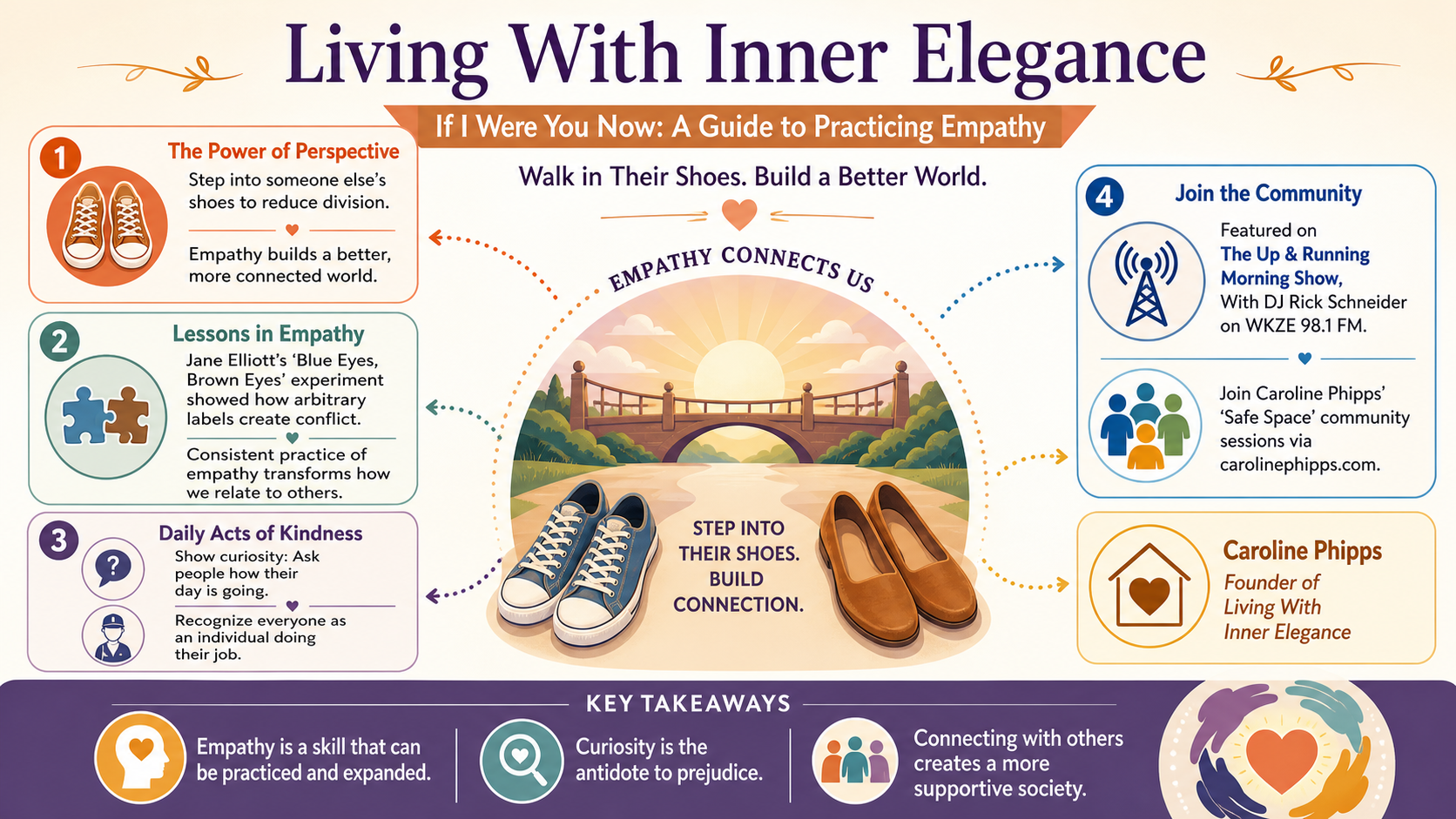
The Up and Running Morning Show with DJ Rick Schneider - Show infographic
Make it stand out
Whatever it is, the way you tell your story online can make all the difference.