
THE ELEGANT SPACE
september 2026
Love and Justice
If we want a more loving society, we can’t remain passive in the face of injustice. Advocating for a just world for all is what love looks like with its work boots on.
When Love Is Not Enough
By Caroline Phipps
I don’t believe that love is the answer to all our problems. No, what the world needs now is people who treat one another justly, and then we’ll have love- sweet love- but you won’t get love until we start providing justice.
Jane Elliott
Anti-Racism Activist and Educator
A few days ago, I sat in a packed theater watching the film “Jane Elliott Against the World.” This timely and powerful 2026 documentary, directed and produced by Judd Ehrlich, centers on legendary educator and anti-racism activist Jane Elliott and her famous and controversial 1968 "Blue Eyes/Brown Eyes" discrimination experiment with third graders in her all-white school in rural Iowa.
At one point in the film, Jane, known for her bluntness about the evils of prejudice and bigotry, says, “I don’t believe that love is the answer to all our problems.” I felt a ripple run through the theater as her words landed uneasily upon many, for whom “all you need is love” had been the soundtrack for much of their lives.
A few weeks before the screening, I had the privilege of having Jane as my guest on my podcast – Living With Inner Elegance Live Talks Series*. At ninety-two and as passionate and committed as ever to the cause of human rights and justice for all, her blunt words didn’t surprise me. While Jane is clearly a very loving and empathetic person (as recent interviews, for example, with her third graders from 1968 attest), she believes the concept of love is overused and has even lost its meaning, becoming a convenient sentimental cop-out that enables people to feel good while doing little to improve their lives, relationships, or society at large.
This belief that love is the answer to all ills is comparatively new. It wasn't until the cultural explosion of the 1960s—fueled by the civil rights movement, the peace movement, and the birth control pill—that many readily embraced the idealized idea that love alone would reshape the world. The events that followed, however, quickly damped down this flame of love and peace.
Before the 1960s, believing that love mattered in any way was considered radical, reckless, and even dangerous. Romantic love was considered particularly perilous, as the tragic endings of Madame Bovary and Anna Karenina, to name but two, so powerfully portray. Beyond romance, however, there was an even bigger warning: let your heart dictate your actions in any way, and it won’t end well. This was because the socio-economic status quo relied on transactional relationships and instincts that kept money, power, and status in the hands of the few at the expense of the many. Sentiment for the many had no place in an unjust world.
Which brings me back to Jane. What is striking is that after over sixty years of confronting the systemic machinery of hatred, bigotry, and prejudice, Jane is staggeringly direct in her observations. She holds no prisoners, calls it as she sees it, and has no time to spare others' delicate feelings when truth is involved. And the painful truth is that during Jane’s lifetime (she was born in the early thirties during the rise of Hitler) and into the present, basic human rights of freedom and protection that showed such budding promise in the days of the March on Washington are now under assault in ways we haven’t seen in decades.
Jane goes on to elaborate on her belief about love’s limitations: “You won’t get love until we start providing justice”. This is why Jane’s life story is particularly compelling for me. For as long as I can remember, I have had a visceral reaction to injustice. As a child, I was always drawn to stories of people and animals being treated unfairly and the courage of those who stood up to help the oppressed, particularly those who advocated for others when they didn’t have to. As a white teacher in an all-white school in an all-white town, she could so easily have kept her views to herself and gone along to get along in the volatile days following the assassination of the Reverend Dr. Martin Luther King Jr.
The intersection of love and justice is one of the most debated topics in philosophy, theology, and civil rights activism, and many activists today, and during the last decades, share Jane’s view that they are two sides of the same coin - the only loving society is a just society.
Philosopher and activist Dr. Cornel West encapsulated this in his famous quote: "Justice is what love looks like in public". To elaborate, while love is often thought of in personal terms, justice is a scaled-up version of love for others and for society, providing the same care, respect, and attention on a societal level with the mission of ensuring everyone has what they need to live a dignified life with their basic needs met.
Easier said than done, however, as standing up for justice is exhausting, even dangerous, as Jane’s life attests. She and her family have paid an enormous price for her passionate advocacy for victims of bigotry and prejudice of every type. Death threats, hate mail, ostracism, and economic fallout, to name but a few.
So, at ninety-two, what lit the initial fire in Jane’s belly and what keeps it burning today? All of this can be encapsulated in a single phrase she often has emblazoned on her white sweatshirt: “There is only one race, the human race.” Jane’s profound love for humanity comes from her belief in the universal truth that we are all interconnected, and what affects one affects all. From a spiritual perspective, the pursuit of justice is the practice of honoring that interconnectedness in how we behave, share resources, and treat one another daily. Justice is the tangible way spiritual love interacts with a broken world. In other words, justice is love with its work boots on.
Jane’s challenge, then, is not to abandon love, but to pull on those work boots, stop using it as a substitute for action, and take steps to make it mean something. We all have something to contribute on this journey.
Don’t think that unless you literally take on the world as Jane has, that’s the only way to make a difference – everything you do makes a difference, however modest it may seem. So, take some time to reflect on what you love, what you are passionate about, what triggers your empathy. In Jane’s case, she had an unhappy childhood, often feeling unloved, unwanted, and marginalized. This pain was the catalyst for her empathic feelings for those who experience prejudice and bigotry not because of how they behave but by simply being who they are through no fault of their own.
Today we are experiencing another evolutionary shift; this time, I believe, way more significant than the 60’s. People across the globe - led by advocates like Jane, for whom love alone is no longer enough- are coming together, marching for universal human rights and justice for our planet.
Impactful advocacy for justice relies on different strengths, resources, and time commitments; choose the approach that works for you. Focus on what you can do, not on what you can’t. Be sure to prioritize care for your own life and needs – not for yourself alone but so that you are better positioned to help others.
Whether your support is local or more global, it all matters. As Archbishop Desmond Tutu warned, “If you are neutral in situations of injustice, you have chosen the side of the oppressor.” We cannot claim to love humanity while remaining passive in the face of its mistreatment. If we want a more loving society, we must first help build a more just one—not only through what we feel, but through what we are willing to do.
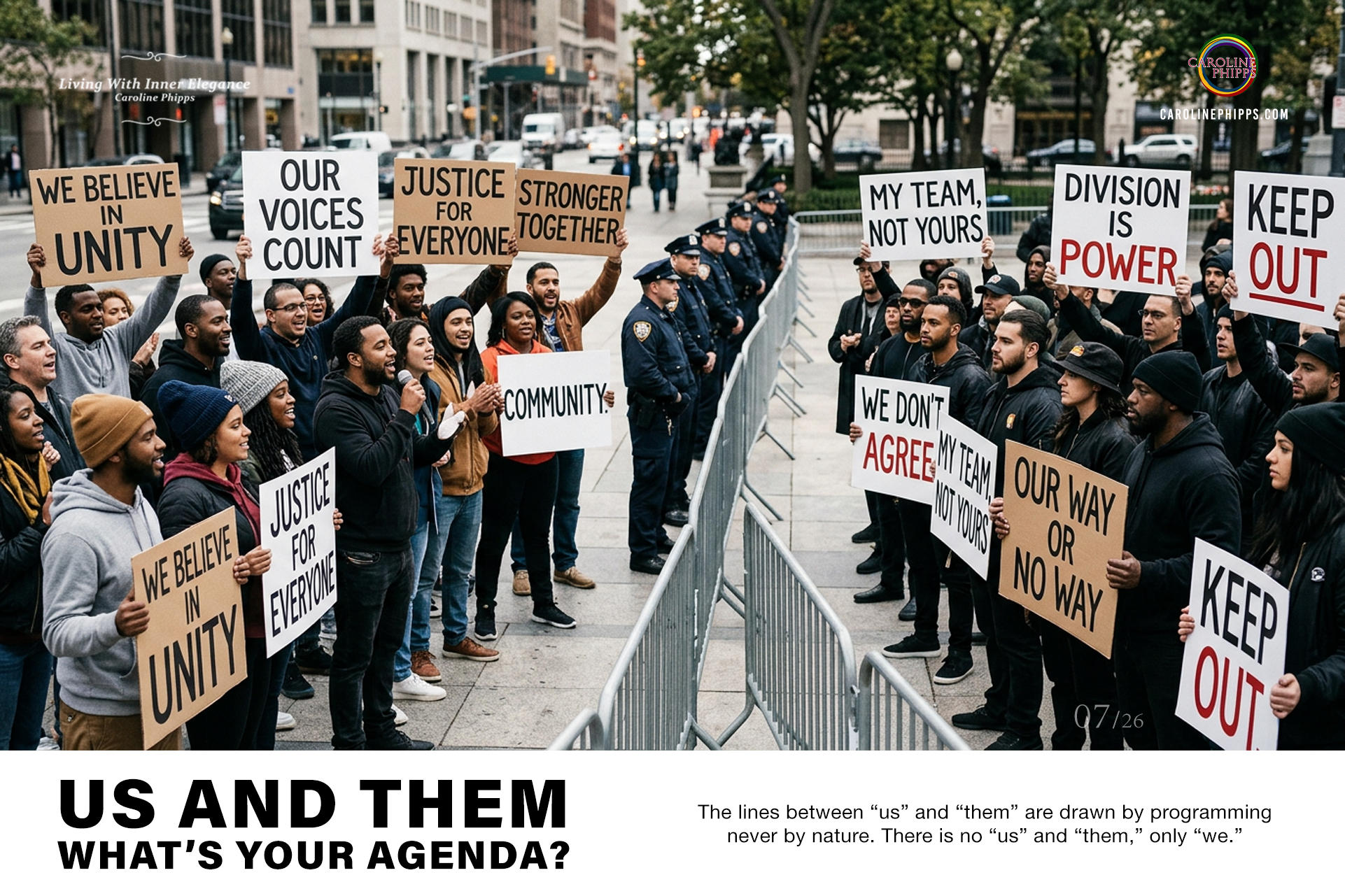
“Us and them” mindset,
Here’s the article:
RELATED RELATED ARTICLES
WATCH JANE ELLIOTT
BLUE EYES / BROWN EYES
1968 EXPERIMENT
For more information about the upcoming Living With Inner Elegance Live Talks Podcast with Jane Elliott, email info@carolinephipps.com.
Download the
love and justice
Infographic

