THE ELEGANT SPACE
July 2026
“Us” and “Them”
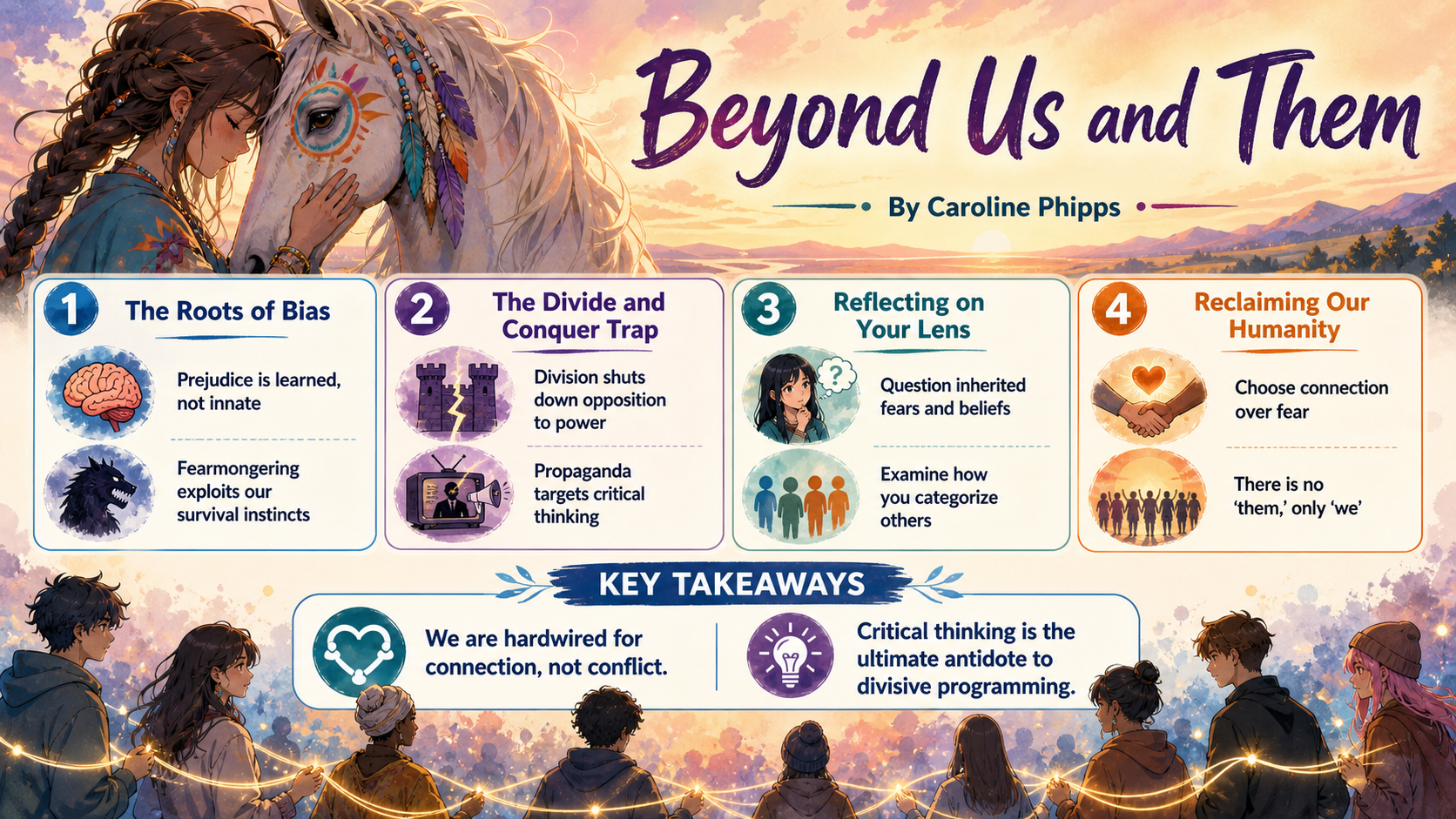
The lines between “us” and “them” are drawn by programming never by nature. There is no “us” and “them,” only “we.”
What’s Your Agenda?
By Caroline Phipps
You’ve got to be taught to hate and fear,
You’ve got to be taught from year to year,
It’s got to be drummed in your dear little ear—
You’ve got to be carefully taught!
Rodgers and Hammerstein
You’ve Got to Be Carefully Taught
Growing up in the early sixties in England, American TV Westerns like Bonanza, Wagon Train, and Rawhide were a BBC staple, and my three older brothers, who loved toy guns and bows and arrows, hero-worshipped these cowboys. My experience was different. Over time, I grew increasingly horrified by what I saw. I couldn’t for the life of me understand why the cowboys were glorified for attacking the Native Americans, who were constantly vilified for their “savage” behavior when defending their lands and way of life. It made no sense to me that people couldn’t leave each other alone or at least try to get along.
This growing perception coincided with my father coming home one day from the cattle market in Oxford, not only with some heifers to add to our herd of cows, but also with the big surprise of a pony for me! The pony was a skinny little fellow who had pulled a milk delivery cart through the back streets of the city, but became redundant when electric vehicles were phased in. He was destined for a very bad place when my father rescued him. As the pony took his first tentative steps off the trailer and into his new life, for me it was love at first sight! The icing on my cake was that he was a painted pony with bold brown and white patches on his body and a luxurious black and white mane and tail. Through my five-year-old lens, he looked exactly like the glorious native horses in the TV Westerns. I immediately christened him Apache, and with my long black hair in braids with feathers, I would ride around the village, living out my fantasy of being an Apache warrior woman.
No two babies come out of the womb the same. We all have unique temperaments, from sensitive and intense to social and calm and various shades in between. Genetics account for about 30% to 60% of these early traits. What we don’t arrive on the planet with is the programming of bias or prejudice of any kind. But inevitably, as we grow and develop, we are understandably prone to absorbing the fears and beliefs of family, environment, and culture, which often exert a great deal of influence. *Multiple Studies in psychology and sociology indicate that while our brains are wired for survival with a capacity for fear and aggression, more complex hatred, bigotry, and prejudice are things we learn.
One aspect of programming is tapping into the primitive and powerful emotion of fear. Because we’re easily scared, fearmongering has always been an easy sell for those with power-hungry, ill intent who cynically exploit our fears to manipulate and control us.
We are all subject to programming, and I was fortunate to grow up in an intellectually open environment and was never judged or reprimanded for opinions that might run counter to mainstream beliefs. My enlightened parents actively encouraged me to be open-minded and curious, and I was exposed to varied influences and a vast range of resources.
Throughout recorded history, there have, of course, been leaders with differing agendas, some enlightened but many driven by their personal fear of survival and the greed it breeds, for whom consolidating their power is the only goal. The challenges we face today, such as the climate crisis, conflict, and accelerating inequality and cruelty, are all symptoms of this primitive fear of survival programming.
This is where the concept of divide and conquer comes in. Encouraging us to turn against one another is a way of shutting down opposition to unpopular policies, which enables the few to consolidate power. This is why people with bad intentions constantly try to divide – households, communities, nations and so on. Propaganda, “alternative facts”, and conspiracy theories are spread while war is waged on education and critical thinking because the biggest threat to the self-serving power grab is an informed, united population capable of standing up for a productive and peaceful society that works for everyone.
What disturbs me most about the state of the world today is this “us” and “them” agenda. When I reflect on my upbringing, it feels so wrong because the interconnectedness of all things was woven into the daily fabric of our lives. On a dairy farm, you’re taught that your survival relies entirely on the health of the animals, the land, and the customers, just as theirs relies on you.
So, I encourage you to take some time to reflect, without judgment, on your upbringing. What were the dominating forces and beliefs you were exposed to? Were you encouraged to be curious and open to others and experiences, or warned about the unsafe state of the world and people who were “different” to you? Did you have ready access to books, information, other cultures and religions? Were you curious about others and questioned what you were taught?
Reflect on where any habitual negative feelings about others originate. What we need to explore here is whether we have learned beliefs that create instinctive and unnecessary separation and division. Consider this: every time we judge people collectively into “us” and “them” (and most of us experience this), we have no idea who the “they” are while we make positive assumptions as to who the “us” are. Every person on this planet is unique. Whether we think of them as one of “us” or one of “them”, some take responsibility for their lives and choices, and some don’t. Some care for others and some don’t. Some have good intentions, and some don’t, and so on.
So, when we find ourselves categorizing others, here are some things to reflect upon:
Do you have an agenda?
Were you taught to be afraid?
Were you taught to feel superior?
Were you taught to feel less than?
It's easy these days to get distracted by the divisions and outrage we’re bombarded with, but I believe we are here for a reason, and our mission today is to rise above divisive programming and reclaim our connectedness. If you’re wondering how this is even possible in today’s divisive atmosphere, here are some questions to help guide us in making everyday choices:
What can we do to improve things today?
Do we help create a sense of safety for others?
Who can we reach out to improve things?
Do we have choices in this situation that benefit everyone, not just me?
Nobody likes to feel like an outsider. It’s a particularly negative emotion because we’re hardwired to connect for survival purposes. When we put others in the “us” and “them” category, we remove ourselves from the flow of life and limit our horizons, opportunities, and experience.
The commitment to the greater good needs to start with yourself. See your own value, learn new things, broaden your horizons, and avoid judging other people’s importance.
If we’re willing to question the lines we’ve been taught to draw between “us” and “them,” we can reclaim something essential: our shared humanity. The sacred truth is that we and our world are connected. At our spiritual core, we are designed for connection, care, and community. The voices that profit from division are loud, but they’re not the only voices. Every day, in seemingly small yet deeply meaningful ways, we get to choose: do we succumb to fear, or choose compassion and connection? Recognizing our common humanity isn’t always easy, but when we do, we create the possibility of a world that works for all of us. The work starts right where we are, with the questions we ask, the stories we challenge, and the courage to see beyond old boundaries. There is no “them” or “us”. There is only “we”.
Blue Eyes/Brown Eyes Exercise: https://en.wikipedia.org/wiki/Jane_Elliott
Download the
US and Them
Infographic