
THE Elegant SPACE
May 2026
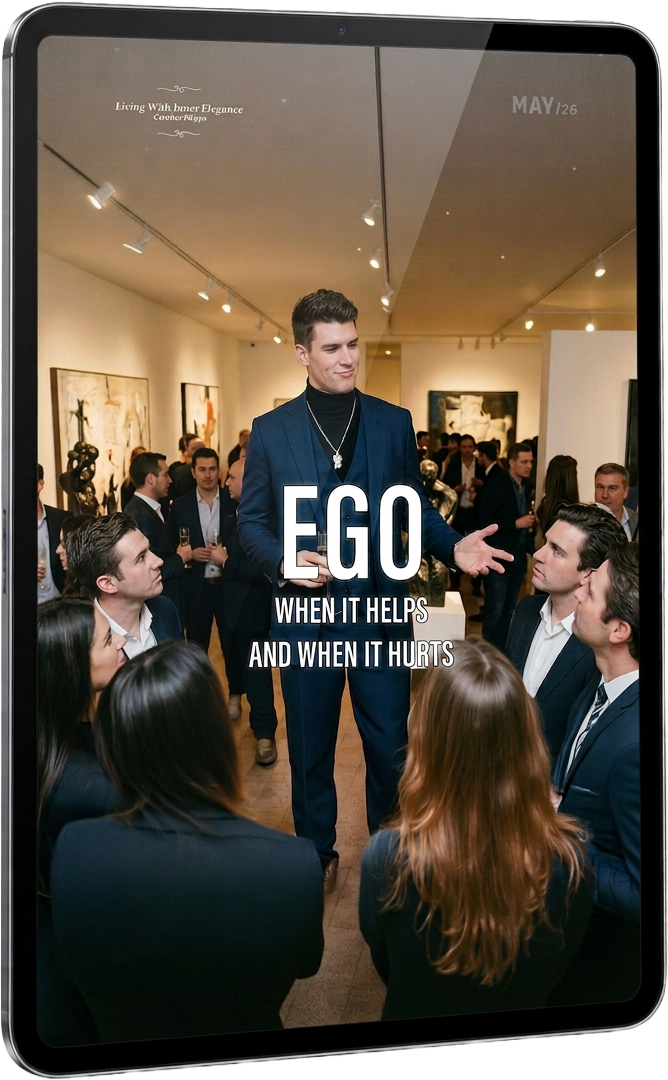
Ego
When It Helps and When It Hurts
Your ego is the powerful lens through which you see yourself and the world. Its influence is so profound that developing a healthy relationship with it is vital in creating a peaceful and purposeful life.
By Caroline Phipps
None are so empty as those who are full of themselves.
Benjamin Whichcote
Provost of King’s College, Cambridge
1609 –1683
Back in the day, I remember there was a boy called Ben in my infant school class who was very naughty. He constantly acted out and blatantly disobeyed the teacher. He was always reprimanded and given a time-out, during which he was made to sit still in a chair and face the wall. I was amazed by his apparent disregard for the teachers and for his long-suffering single mother. I knew that Ben was somehow different from me, but I had no idea why or what made him that way. I would rather have died than suffered such humiliation, and I always wondered how he could care so little. It was mystifying.
It wasn’t until I was in my early twenties that I fully grasped that everyone has their own take on the complicated business of living and that people experience life very differently. The idea that I was the only one experiencing what I was experiencing every day was simply staggering. I realized that was what accounted for the great feeling you get when you interact with someone who seems to share your feelings about something and to understand you better than most. But it also accounts for the alienation you feel when you feel out of step with others and maybe even misunderstood by them.
So where does this sense of separateness come from? After all, we’re all in this together, spinning through space on Mother Earth. Psychologists, philosophers, and spiritual traditions share the view that it comes from an identifiable part of us called the ego. This is the part that draws a line between “me” and “everyone else.” The ego’s there to protect us, safeguarding our sense of self, like an early warning system. It’s constantly scanning for threats—rejection, betrayal, failure—and does its best to keep us safe.
In Carl Jung's model of the psyche, the ego represents the center of consciousness, the viewpoint from which we consciously experience the world. It accounts for the voice in our heads that defines who we are, what we value, and how we perceive our own identity and worth in the world.
And here’s where things can get tricky. The ego’s voice can be so convincing that we start believing its version of events is the only one there is. Plato brilliantly used a cave-dwelling analogy to adeptly illustrate what this myopic view of the world sees. Picture yourself sitting in a cave with your back to the light, watching shadows dance on the wall in front of you. If you never turn around toward the light, the shadows are all you’ve ever seen. It makes sense, then, that you believe that your limited view is all there is. You’ve never seen the reality outside.
I believe this limited, cave-dwelling existence is what the Buddha alluded to when he taught that the world we perceive is an illusion. The idea that what we experience in this life is a misleading impression of reality is extremely hard to grasp. Try explaining that it’s all an illusion when you stub your toe on the pavement. The pavement is solid concrete, and your pain is real.
What the Buddha meant was that this doesn't mean nothing exists, but that our perceptions are shaped by our own stories, and we forget that everyone else has their own unique lens, too, which creates a completely distorted perception of reality.
The ego, then, is mighty powerful. It shapes how we relate to others and to ourselves.
Understanding and managing our egos is one of our greatest challenges because the ego determines the quality of our relationships with others and whether we have a destructive sense of self-importance or a healthy sense of self-esteem.
So, why do we sometimes end up with an overblown ego? This is when our deep-seated insecurities and fear of survival create an overinflated ego that becomes a subconscious protective shield. It is a mechanism deeply rooted in our sense of belonging and identity because, as we grow, we learn to associate our worth with praise, achievements, and social status. The overinflated ego, then, is the framework we develop to secure external validation, in the hope of remaining safe and valued in our environment. We build up this facade of self-importance to compensate for our internal lack of belief in our own worth.
The dangers of inflated and unchecked egos can be seen throughout human history, manifesting in deadly and destructive behavior towards others and the world. When a person's ego goes unchecked, they have no regard for others, only judgment. Life is seen solely as a competition – winner takes all - which translates into no capacity for compassion or empathy. Couple this with bluff and bluster, the need to always be right, the demand for constant admiration, a lack of capacity to take responsibility, and an intense fear of failure, and you have a recipe for disaster, particularly when such people attain a prominent and influential position over others.
On a healthy level, however, the ego gives us the belief in ourselves. With a solid sense of our own worth, we have the confidence, life force, and courage to pursue a life of purpose because our validation comes from within. It does not rely on others. We don’t see the world in competitive terms, but rather collaboratively. There’s no need to belittle others, and constructive criticism is a tool for learning and growth because we believe there is always room to improve.
Your relationship with your ego makes all the difference in the quality of your life. The difference between feeling confident and constantly doubting yourself. The difference between being comfortable in your own skin and always needing to prove something. Understanding why you have an ego and recognizing its purpose as a protective mechanism can give you a better perspective on how to manage your own tendencies and interact with others more effectively.
People with healthy self-esteem are a joy to be around. They connect easily, set boundaries thoughtfully, and handle life’s ups and downs with resilience. On the flip side, inflated self-importance puts up barriers and turns relationships into a contest. Being too big for your boots, as the saying goes, is alienating and makes others uncomfortable.
So, how can you create a healthier relationship with your ego?
Practice humility: Unhealthy pride can make you arrogant, defensive, unteachable, boastful, entitled, and envious, so practice swallowing your pride and showing humility.
See mistakes as lessons, not threats to your identity.
Remember, your worth isn’t tied to your achievements or what others think of you.
Take a little time each day to reflect on what makes you, you. Your strengths, your values, the things you bring to the table—they’re what make you special and connect you to others.
In the end, the ego isn’t your enemy or your savior—it’s simply part of being human. It’s the lens that shapes how you see yourself and everyone around you. The trick is learning to notice when your ego is detrimental to your life and consciously invite it to step aside, so you can get a clearer, healthier picture of the world. When you do, you’ll find it’s possible to move through the world with a quiet confidence that doesn’t need to shout, compete, or prove its worth. Instead, you’ll show up with inner elegance—a sense of alignment that creates confidence and ease, to connect authentically with others while making life feel lighter for you and everyone around you.
Listen to the radio show on
ego
aired on
May 26, 2026, 9 am
download
ego
ebook
read
ENTITLED
UNDERSTANDING YOUR PRIVILEGE
published in june 2025

