What Will it Take to Change the World?
Listen to the radio show on ‘into the future’
WKZE 98.1 FM, RED HOOK, NY
SHOW SUMMARY
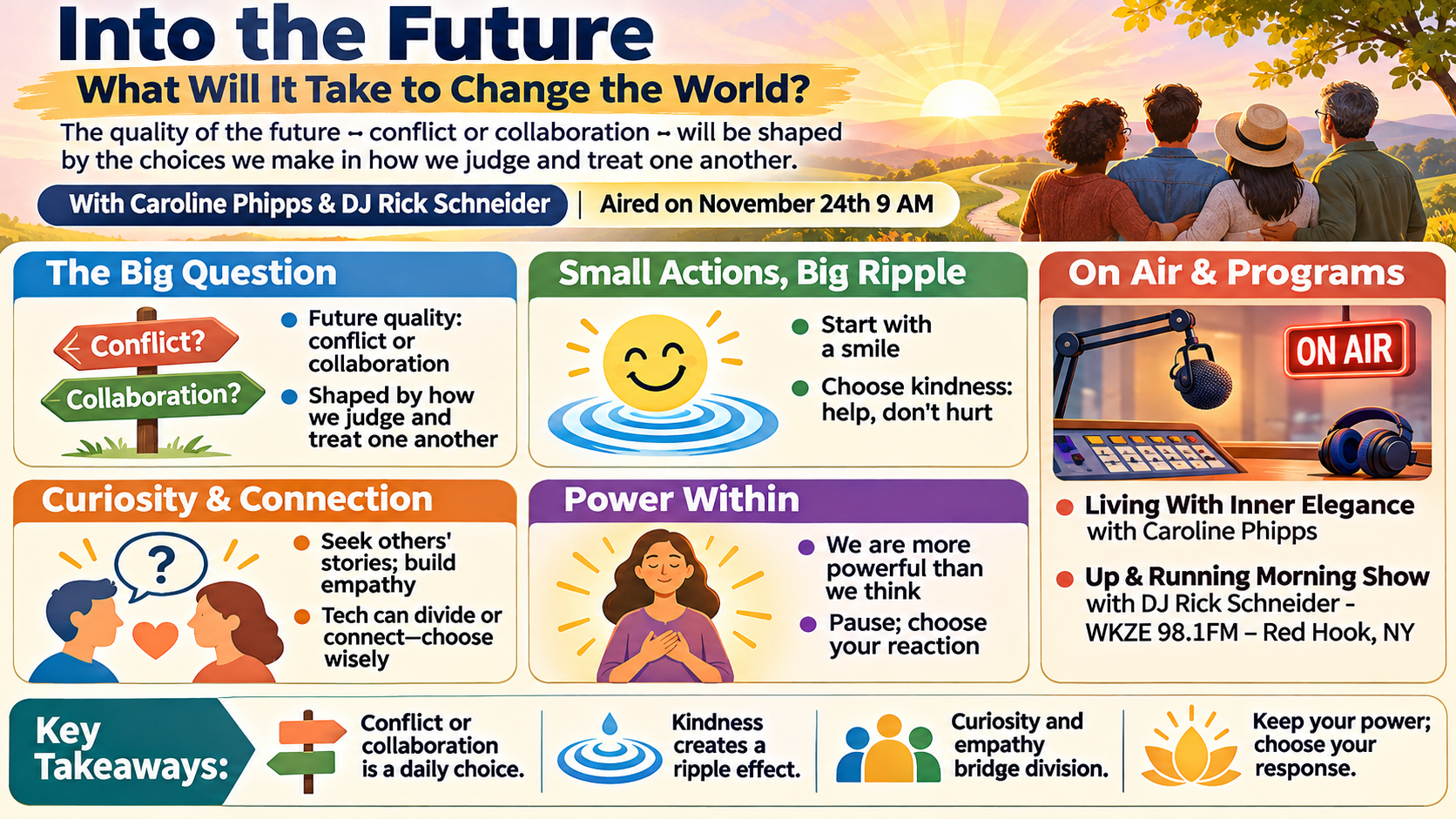
This episode of the Up and Running Morning Show features Caroline Phipps, founder of Living with Inner Elegance, discussing the profound yet practical question: What will it take to change the world? Drawing from personal experience, conversations with a combat veteran, and reflections on technology, human connection, and individual choices, Caroline emphasizes the power of small, everyday actions and the importance of empathy, curiosity, and unity.
1. The Core Question: What Will It Take to Change the World?
Caroline introduces the topic through a conversation with her friend Jason Larimore, a combat veteran and program director of Heroes and Horses, who posed the profound question. She relates this back to her own work, suggesting that changing the world boils down to incremental, simple acts that improve our collective experience.
Much of Caroline’s work over the years revolves around tangible steps individuals can take to improve the world.
The challenge often seems overwhelming, but small, positive choices accumulate.
Daily decisions, such as what kind of news we consume, shape our outlook and influence others.
2. The Impact of Personal Choices and Mindset
Caroline shares how early exposure to negative and sensationalized news started to affect her wellbeing over time, leading to a deliberate shift:
She stopped reading conventional news sources and instead focused on disseminating good news to brighten people’s days.
This change is a metaphor for the broader principle: we each have the power to choose positivity or negativity, which has a cumulative global effect.
The ability to decide how we respond emotionally and behaviorally is a fundamental power everyone holds.
3. Empathy, Curiosity, and Understanding as Foundations for Change
Recognizing the complexity of over 8 billion people living diverse lives, Caroline highlights:
The importance of cultivating curiosity about others’ lives, backgrounds, and experiences.
Through curiosity, we develop empathy—understanding why people behave the way they do and what shaped them.
Empathy then drives more informed and fair decisions rather than simplistic acceptance or rejection.
4. Technology’s Dual Role: Division and Connection
Caroline discusses the double-edged nature of technology in world change efforts:
Social media and digital platforms can create division by emphasizing tribalism and “otherness.”
Conversely, technology provides unprecedented access to real stories from conflict zones (e.g., Ukraine, Gaza), evoking compassion and global solidarity.
The impact depends on how people choose to use technology—for division or connection.
5. The Power and Simplicity of Human Kindness
Central to Caroline’s message is the power of small acts of kindness, especially as simple as a smile.
Smiling at strangers reduces perceived threat, creating openings for kindness and connection.
She shares a personal story about how a smile and friendly greeting transformed a worried stranger’s day.
Such moments, when multiplied, contribute to collective change.
Key insight:
Change often begins with nonverbal communication— a smile signals safety and goodwill, breaking down barriers.
6. Challenges Amplified by the Pandemic
The pandemic restricted simple human connections, such as smiling or close interaction due to masks and distancing, which:
Made it harder for people to connect emotionally.
Increased feelings of isolation and loneliness.
Highlighted how much small social gestures matter for emotional wellbeing.
7. Overcoming Division and Embracing Shared Humanity
Caroline stresses the futility of division based on arbitrary factors like nationality, race, or tribe:
She recalls a disturbing personal experience where she was asked, “Are you one of us?” illustrating exclusionary mindsets.
The ultimate truth is we are all part of one human family sharing DNA and dependence on the earth.
Quoting Helen Maud Cam, a pioneering historian:
"Civilization is the art of living together with people not entirely like yourself."
This quote encapsulates the idea that to thrive collectively, we must embrace diversity, tolerate differences, and cooperate.
8. Fairness, Equity, and Informed Compassion as Practical Goals
For Caroline, empathy is not about blind acceptance but about gaining insight to make choices promoting fairness, equity, and human dignity.
She differentiates empathy from unconditional agreement, emphasizing informed decisions about what is just.
Encourages daily actions that promote fairness and decency within communities.
9. Combating Overwhelm by Reclaiming Personal Power
Many feel overwhelmed by global issues and assume individual efforts won't matter, leading to passivity. Caroline counters that:
Everyone possesses significant inner power via mindset, spirit, and choices.
Reclaiming this power starts by refusing to be reactive and choosing positive, measured responses.
This personal empowerment is a “superpower” that grows stronger with practice and has a ripple effect.
10. Collective Impact Through Individual Actions
Caroline celebrates that even small groups of people committed to positivity can counteract negativity:
Seven people doing good in a room can create meaningful change.
Collective power comes from many individuals reclaiming agency and acting ethically.
Society often looks outward for solutions, but solutions start from within each person.
Summary of Key Insights
Changing the world starts with individual choices and simple acts of kindness.
Curiosity and empathy toward others enable deeper understanding and fairness.
Technology is a neutral tool—its impact depends on how we use it.
Small gestures, like a smile, have significant ripple effects on social connection.
Inner power to choose responses builds resilience and positive influence.
Overcoming tribalism and division requires embracing shared humanity and living together respectfully.
Collective positive action grows from many individuals reclaiming their power and acting consciously.
Caroline Phipps’ message is ultimately hopeful and pragmatic: each person contributes to global change through actions, attitudes, and awareness—one simple step, one connection, one choice at a time.