NOV 04/2026
Guest: Jane elliott - american diversity educator
Summary
Jane Elliott’s Blue Eyes/Brown Eyes Experiment and Its Enduring Impact on Combating Racism
Jane Elliott’s pioneering “Blue Eyes/Brown Eyes” experiment, sparked by the assassination of Martin Luther King Jr. in 1968, revolutionized experiential learning about racism. Her courageous teaching challenged ingrained societal prejudices by placing third-grade students in an intense, eye-opening exercise that revealed how arbitrary physical traits are weaponized for discrimination. This interview explores Elliott’s motivations, the powerful impact of her work on students and society, her reflections on systemic racism today, and ongoing efforts for equity and education.
1. Origins and Impact of the Blue Eyes/Brown Eyes Experiment [00:01]
Jane Elliott created this groundbreaking exercise immediately following MLK’s assassination, aiming to educate her all-white rural Iowa third graders about the cruelty and absurdity of racial prejudice.
Elliott witnessed firsthand the shocking reality of racism while living in Waterloo, Iowa, amidst Black communities, challenging previous biases she had been taught [07:20].
Motivated by anger and grief, she divided her class by eye color, arbitrarily assigning superiority and discrimination to groups as a metaphor for racial segregation and prejudice [10:30].
The exercise involved:
Privileged “blue-eyed” children receiving extra recess and being praised as smarter.
“Brown-eyed” children being marginalized, forbidden from using drinking fountains, and forced to wear collars marking inferiority [11:27].
The immediate behavioral transformations were dramatic, with children quickly adopting hostile, discriminatory behaviors mirroring societal racism [15:14].
Crucially, Elliott reversed the roles the following week, revealing how oppression feels when experienced firsthand and showing that retaliation is not the goal but empathy and equity are [20:20].
Students internalized powerful lessons: refusing to "get even," choosing instead understanding and fairness, which Elliott regards as a key insight for combating systemic racism [23:06].
2. The Pedagogical Philosophy and Courage Behind the Experiment [35:10]
Elliott credits her father’s clear moral guidance—“You know the difference between right and wrong; now do the right thing”—as the foundation of her courage.
Despite social, professional, and personal pushback—including racist remarks from fellow teachers and community members—Elliott stood firm, prioritizing educating children on real equality [36:10].
She deliberately used experiential learning, believing people only understand injustice once they have personally lived it, aligned with the Sioux proverb: "Never judge a man until you've walked a mile in his moccasins" [01:13:17].
Elliott stresses the importance of active resistance to racism in daily interactions, calling for individuals to challenge racist speech immediately rather than tolerate it [39:19].
She supports literacy as a crucial tool: sustained silent reading every night builds critical thinking necessary to counter racist indoctrination from media and societal conditioning [40:32].
3. Legacy and Long-Term Outcomes of the Experiment [24:22]
The experiment had profound, lasting effects on Elliott’s students and beyond:
Former students reflect that the exercise changed their views and relationships with others profoundly, leading to more inclusive, understanding communities [56:18].
Elliott emphasizes that teaching from kindergarten through third grade is crucial to dismantling racist conditioning before it becomes entrenched [01:17:40]
4. Contemporary Reflections on Racism, DEI, and Education [45:57]
Elliott offers a critical assessment of today's social climate and educational challenges:
She notes the rollback of civil rights and DEI (Diversity, Equity, Inclusion) initiatives, attributing resistance to fear among so-called white majorities of losing power and cultural dominance [46:59].
Uses the human body analogy: diversity is like the diverse cells in a body—they must all be treated equitably to survive and thrive [47:36].
Calls out misleading education systems that perpetuate myths about race and history, such as the use of skewed Mercator maps versus more accurate Peters Projection maps, which distort global perspectives [30:16].
Criticizes media and political leaders who stoke division and uphold misconceptions about race, urging people to exercise their right to vote and "refuse to go along" with racism and ignorance [59:17].
Highlights the danger of "power worshippers," a term she borrows from a book outlining those who profit from social division and authoritarianism [58:10].
5. Expansion of the Experiment and Global Relevance [51:35]
Elliott has taken the core message beyond the U.S., contextualizing it globally.
Racism and power dynamics are universal, manipulated by elites to maintain control [52:03].
The demographic shifts toward a more diverse population cause anxiety in some groups, driving resistance to equity efforts [52:28].
Elliott’s work underscores the importance of educating people worldwide about the shared human origin of all races—an essential truth to end racism [50:07].
6. Experiential Learning vs. Legal/Civic Remedies [01:12:00]
Jane Elliott stresses that legal frameworks alone cannot eradicate racism without the emotional and experiential understanding of discrimination.
The Blue Eyes/Brown Eyes exercise emotionally immerses participants to feel racial bias, which laws cannot replicate [01:13:34].
Experiential learning invokes empathy, creating personal conviction to combat injustice [01:14:45].
Students from Elliott’s program have challenged racist teachers and behaviors themselves, demonstrating empowerment through knowledge [01:15:33].
7. The New Documentary and Continuing Advocacy [01:06:00]
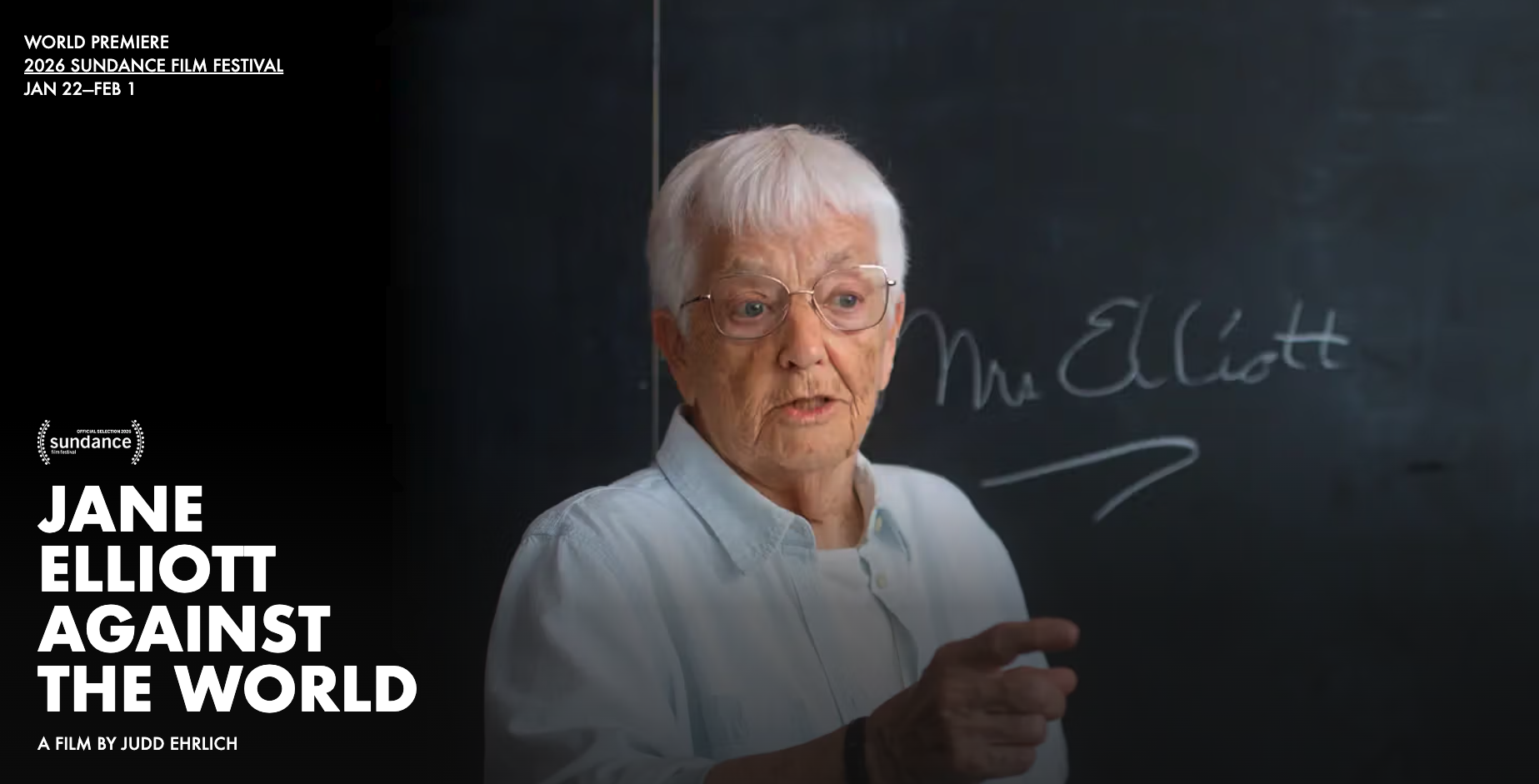
A documentary titled Jane Elliott Against the World premiered at Sundance, celebrating and documenting her lifelong fight against racism [01:06:10].
The film is slated for educational use in schools in small segments to effectively teach about racism without overwhelming students [01:07:39].
Elliott encourages teachers and activists to utilize these resources to spread awareness [01:01:18].
8. Defining Racism and Responsibility [01:36:43]
In a direct Q&A, Elliott defines key perspectives on race and racism:
Key Insights
Racism is a learned behavior, perpetuated by societal structures and education that can and must be unlearned through honest, experiential teaching.
The Blue Eyes/Brown Eyes experiment powerfully simulates discrimination, fostering empathy and a lasting anti-racist mindset in participants.
Equity, inclusion, and honest education about history and race are critical for societal health and democracy—resistance to these is tied to power fears and misinformation.
Early education is the front line for combating racism effectively.
The legacy of Jane Elliott demonstrates that individual courage in education can challenge systemic injustice, despite opposition.
Recommended Resources from Jane Elliott
Books to understand and combat racism, including The Power Worshippers and The Myth of Race [58:10, 01:00:00].
Peters Projection map, recommended over Mercator, to correctly represent global geography and challenge biased worldview [01:34:27].
Educational materials available at jane@janeelliott.com, including clarifications on common misconceptions and commitment pledges [01:01:18].
This content reveals Jane Elliott’s unwavering commitment to educating against racism through compelling experiential methods, her critique of systemic failures, and her hope for a future shaped by truth, courage, and inclusion. Her work remains urgently relevant amid present-day challenges around civil rights and societal division.
watch pbs/frontline documentary
A class divided
watch smithsonian channel documentary
MLK: The Assassination Tapes
watch Channel 4 documentary
The Event: How Racist Are You with Jane Elliott
learn more about the documentary
Jane Elliott Against the World